“Not Cost-effective”

The two stories appearing side by side on page 8 of the EVENING STANDARD’s edition on Wednesday 2 March 2016, appeared to be unrelated:

  1. The most-signed Parliamentary petition in history for the meningitis vaccine to be extended from babies to all children under 11 yrs old was dismissed by the Government as “not cost-effective.”
  2. The extension of the Sate Pension Age to 69 yrs by the 2040s, possibly abandoning the concept altogether and declaring the State Pension to be a minimum requirement to be topped up to a ‘living pension’ by private funds.  This I assume to be the result of a “cost-effectiveness” exercise.

I began to surmise how our current Government defines “cost effectiveness,” particularly as it continues to award itself inflation-busting pay rises while it seeks to reduce, in real terms, both the pay of ‘ordinary’ public employees and the justifiable benefits of disabled persons.

Being a public sector employee myself, involved with public procurement, I’m well versed in the principles of Value for Money and the concept of balancing price or cost (including cost in use or lifetime cost) against quality and non-cost criteria.  However, I’m also well aware of the requirement to make the criteria upon which evaluations will be evaluated open and transparent.  To that end, I’ve spent many hours setting out such criteria and weightings and making them known to companies who will be evaluated.  Indeed, it is a legal requirement to make those criteria and weightings available to all companies who may be interested in tendering for a public contract.

So why do the very people who legislate for others pay little regard to their own rules when carrying out cost effectiveness evaluations for such things as saving children’s lives and providing for the welfare of disabled persons and the elderly?

Back to my surmise that it’s down to “Do what I say and not what I do.”

On an unrelated matter, I also wonder how both sides of the “Brexit” discussion evaluate the cost-effectiveness of remaining within or withdrawing from the EU.  Answers please.

Old: When people don’t recognise your cultural influences

When your teenage heroes appear in the obituary columns on a regular basis, when you have to ask people to repeat themselves (whether or not it was because they spoke too fast or in abbreviated form) or when people offer you their seat on the tube, you realise you are getting old.  But when you try to make a witty statement at work, describing your one man team as Zaphod Beeblebrox, and the response is “Who?” you realise that you have actually achieved the status of ‘old’.

For the enlightenment of my colleagues, none of whom was aware of Douglas Adam’s creation in The Hitchhiker’s Guide to the Galaxy, ex-Galactic President Zaphod Beeblebrox hatched grand schemes with the assistance of his ‘team’, a second Zaphod Beeblebrox head sprouting from his shoulders.   I have to admit that before the advent of CGI, the image was pretty awful, but with a bit of ‘suspension of disbelief’ you could accept that such a being could, possibly, exist.

I wasn’t a massive fan of Hitchhiker, but, along with most people of my generation, I was at least aware of it’s theme, the main characters and the basic storyline.  I suppose there was such relatively little content on radio, television and film in my youth, it was easy to be reasonably au fait with a large proportion of that content.  But with the proliferation of radio and television stations, and the massive growth of film studios throughout the world, together with an ability to access it all at the touch if a digital button, it must be difficult to avoid being selective.

Even listening to modern music (which all sounds the same to me, in general terms), we are required to choose between ‘House’, ‘Garage’, ‘Drum and Base’ and multitudes of other variations on the delivery of twelve semitones across a number of octaves by musical instruments that have not changed wildly in the past few decades.  Why are we required to nail our musical preferences to one particular mast?  Because there’s so much of it, we can’t possibly include everything in our taste collection?  Either that or the world’s addiction to sound bites, Excecutive Summaries, bullet points  and dumming down has reduced the ability of our brains to store more than a few megabytes of acquired information.

This is where my SCUI (Spinal Column USB Interface) will make a difference.  In the next few months I’ll be launching a Crowd Funding Appeal for the development and production of a range of memory enhancing products, ranging from a neural implant interface with USB4 inputs to implanted SSDs of various capacities and Bluetooth enabled devices. Unless, of course, Apple have already patented my innovative idea and intend interfacing their iMemory with the iPhone and Apple Watch to synchronise on the iCloud.  I can’t really imagine that old iTim thought of it first!

42 Incorrectly Used Words That Can Make You Look Dumb

LinkedIn Influencer, Jeff Haden, published this post originally on LinkedIn, and I rather like it. I’ve added a couple of words to the list that irk me and Anglicised it a bit. But essentially, everybody should be wary of the traps.

While I like to think I know a little about business writing, I still fall into a few word traps.
Just as one misspelled word can get your resume tossed onto the “nope” pile, one incorrectly used word can negatively impact your entire message. Fairly or unfairly, it happens – so let’s make sure it doesn’t happen to you.

Adverse and averse
Adverse means harmful or unfavourable: “Adverse market conditions caused the IPO to be poorly subscribed.” Averse refers to feelings of dislike or opposition: “I was averse to paying £18.00 a share for a company that generates no revenue.”
But hey, feel free to have an aversion to adverse conditions.

Affect and effect
Verbs first. Affect means to influence: “Impatient investors affected our roll-out date.” Effect means to accomplish something: “The board effected a sweeping policy change.”
How you use effect or affect can be tricky. For example, a board can affect changes by influencing them and can effect changes by directly implementing them. Bottom line, use effect if you’re making it happen, and affect if you’re having an impact on something that someone else is trying to make happen.
As for nouns, effect is almost always correct: “Once he was fired he was given 20 minutes to gather his personal effects.” Affect refers to an emotional state, so unless you’re a psychologist you probably have little reason to use it.

Bring and take
Both have to do with objects you move or carry. The difference is in the point of reference: you bring things here and you take them there. You ask people to bring something to you, and you ask people to take something to someone or somewhere else.
“Can you bring an appetizer to John’s party”? Nope.

Consortium and consortia
A Consortium is a group of people or companies that is formed for a particular endeavour or project with a common goal. Consortia are a number of such ‘organisations’.
I and my colleagues, together, can make a consortium bid for a project, and a number of consortia can each make a consortium bid. But nobody or bodies can be part of a consortia or make a consortia bid.  They can, of course be members of a number of consortia.

Compliment and complement
Compliment means to say something nice. Complement means to add to, enhance, improve, complete, or bring close to perfection.
I can compliment your staff and their service, but if you have no current openings you have a full complement of staff. Or your new app may complement your website.
For which I may decide to compliment you.

Criteria and criterion
“We made the decision based on one overriding criteria,” sounds fairly impressive but is also wrong.
Remember: one criterion, two or more criteria. Or just use “reason” or “factors” and you won’t have to worry about getting it wrong.

Discreet and discrete
Discreet means careful, cautious, showing good judgment: “We made discreet inquiries to determine whether the founder was interested in selling her company.”
Discrete means individual, separate, or distinct: “We analysed data from a number of discrete market segments to determine overall pricing levels.” And if you get confused, remember you don’t use “discretion” to work through sensitive issues; you exercise discretion.

Elicit and illicit
Elicit means to draw out or coax. Think of elicit as the mildest form of extract. If one lucky survey respondent will win a trip to the Bahamas, the prize is designed to elicit responses.
Illicit means illegal or unlawful, and while I suppose you could elicit a response at gunpoint … you probably shouldn’t.

Farther and further
Farther involves a physical distance: “Florida is farther from New York than Tennessee.” Further involves a figurative distance: “We can take our business plan no further.”
So, as they say in the South, “I don’t trust you any farther than I can throw you,” or, “I ain’t gonna trust you no further.”

Fewer and less
Use fewer when referring to items you can count, like “fewer hours” or “fewer dollars.”
Use “less” when referring to items you can’t (or haven’t tried to) count, like “less time” or “less money.”

Imply and infer
The speaker or writer implies, which means to suggest. The listener or reader infers, which means to deduce, whether correctly or not.
So I might imply you’re going to receive a raise. And you might infer that a pay increase is imminent. (But not eminent, unless the raise will somehow be prominent and distinguished.)

Insure and ensure
This one’s easy. Insure refers to insurance. Ensure means to make sure.
So if you promise an order will ship on time, ensure that it actually happens. Unless, of course, you plan to arrange for compensation if the package is damaged or lost — then feel free to insure away.
(While there are exceptions where insure is used, the safe move is to use ensure when you will do everything possible to make sure something happens.)

Irregardless and regardless
Irregardless appears in some dictionaries because it’s widely used to mean “without regard to” or “without respect to”… which is also what regardless means.
In theory the ir-, which typically means “not,” joined up with regardless, which means “without regard to,” makes irregardless mean “not without regard to,” or more simply, “with regard to.”
Which probably makes it a word that does not mean what you think it means.
So save yourself a syllable and just say regardless.

Number and amount
I goof these up all the time. Use number when you can count what you refer to: “The number of subscribers who opted out increased last month.” Amount refers to a quantity of something that can’t be counted: “The amount of alcohol consumed at our last company picnic was staggering.”
Of course it can still be confusing: “I can’t believe the number of beers I drank,” is correct, but so is, “I can’t believe the amount of beer I drank.” The difference is you can count beers, but beer, especially if you were way too drunk to keep track, is an uncountable total and makes amount the correct usage.

Precede and proceed
Precede means to come before. Proceed means to begin or continue. Where it gets confusing is when an –ing comes into play. “The proceeding announcement was brought to you by…” sounds fine, but preceding is correct since the announcement came before.
If it helps, think precedence: anything that takes precedence is more important and therefore comes first.

Principal and principle
A principle is a fundamental: “Our culture is based on a set of shared principles.” Principal means primary or of first importance: “Our startup’s principal is located in NYC.” (Sometimes you’ll also see the plural, principals, used to refer to executives or relatively co-equals at the top of a particular food chain.)
Principal can also refer to the most important item in a particular set: “Our principal account makes up 60% of our gross revenues.”
Principal can also refer to money, normally a sum that was borrowed, but can be extended to refer to the amount you owe — hence principal and interest.
If you’re referring to laws, rules, guidelines, ethics, etc., use principle. If you’re referring to the CEO or the president (or an individual in charge of a high school), use principal.

Slander and libel
Don’t like what people say about you? Like slander, libel refers to making a false statement that is harmful to a person’s reputation.
The difference lies in how that statement is expressed. Slanderous remarks are spoken while libellous remarks are written and published (which means defamatory tweets could be considered libellous, not slanderous).
Keep in mind what makes a statement libellous or slanderous is its inaccuracy, not its harshness. No matter how nasty a tweet, as long as it’s factually correct it cannot be libellous. Truth is an absolute defence to defamation; you might wish a customer hadn’t said something derogatory about your business… but if what that customer said is true then you have no legal recourse.
And now for those dreaded apostrophes:

It’s and its
It’s is the contraction of it is. That means it’s doesn’t own anything. If your dog is neutered (the way we make a dog, however much against his or her will, gender neutral), you don’t say, “It’s collar is blue.” You say, “Its collar is blue.”
Here’s an easy test to apply. Whenever you use an apostrophe, un-contract the word to see how it sounds. Turn it’s into it is: “It’s sunny,” becomes, “It is sunny.”
Sounds good to me.

They’re and their
Same with these: They’re is the contraction for they are. Again, the apostrophe doesn’t own anything. We’re going to their house, and I sure hope they’re home.

Who’s and whose
Whose password hasn’t been changed in six months?” is correct. Use the non-contracted version of who’s, like, “Who is (the non-contracted version of who’s) password hasn’t been changed in six months?” and you sound a little silly.

You’re and your
One more. You’re is the contraction of you are. Your means you own it; the apostrophe in you’re doesn’t own anything.
For a long time a local not for profit organisation displayed a huge sign that said, “You’re Community Place.”
Hmm. “You Are Community Place”? No, probably not.

Now it’s your turn: any words you’d like to add to the list?

Priority seats: at what point does one become eligible?

As my years have advanced, I have to understand that others may view me as a member of that group who deserve special treatment.   When that special treatment results in reduced cost cinema seats, I’m quite willing to accept the classification.  If I receive free pharmacy prescriptions because I’m over the age of 60, that doesn’t seem to be too much of a cross to bear.

However, when I was first offered a seat on the tube by someone who appeared not so very much younger than me, I was (inwardly) affronted.  Did I not bound up the excruciatingly long escalator from the Central Line to the Metroplitan Line at Liverpool Street every weekday morning, leaving younger travellers in my wake?  Have you not seen me racing from the Circle Line to the Metroplitan Line at Baker Street?  How dare you!  However, the offer of a seat in the usually packed, sweaty, airless Central Line cars is too much to refuse, and I overcame my effrontery, allowed myself to look older than I felt and sat down.

Did that one act of ‘helplessness’ affect my better judgement?  As a person who has been accepted as one ‘less able to stand’, have I now decided that I qualify for the ‘disabled, pregnant or less able to stand’ seats?  Just how ‘less able’ am I?  Clearly, the priority has to be disabled (permanently or temporarily), followed closely by pregnant.  But is there a pecking order for limited ability to stand? And once I decide that another passenger has greater inability to stand than I, should the whole carriage shuffle around and reorder themselves, offering a seat to the next less able to stand?

I am ashamed to say that today, I manoeuvred myself into a ‘less able to stand’ seat in front of a considerably older and considerably less able to stand gentleman.  He even had a walking stick (which I had previously noted he didn’t use along the platform, although he did have a bit of a shuffling gait and a slightly odd arm – in hindsight, probably the victim of a stroke).  Elderly gentleman stared at me and, aghast, a young woman in the opposite ‘less able to stand’ seat gave up her position.  For the two or three following stations they both huffed and stared at me – a ‘perfectly capable of standing’ passenger.  Wait a minute, she wasn’t disabled or pregnant, and she was far more capable of standing than me!  And they departed after two and three stations, whilst I was committed to a journey of nineteen!  Surely I qualified for the ‘less able to stand’ seat.

No, to be quite honest, I didn’t and hope I won’t qualify for some years to come.

Sorry, elderly and less able to stand gentleman at Bond Street.

When a Jubilee Line train derails out of Baker Street

June 2014 updated April 2016

“Dear London Tube:

“I thought I’d drop you a note about the uncomfortable, if not dangerous, state of the Jubilee tube track south bound out of Baker Street, possibly echoing reports from your drivers.  Some 10-20 metres out of the platform there is sudden jolt to the left.  The first time I experienced this, I banged my head on the superstructure, causing much merriment amongst my fellow travellers.  On the second and third times I was more aware, but forgetfulness returned on the fourth occasion, and head got a severe bang again – and probably further memory loss!   I’ve now pretty much got used to it, but feel that the wearing of a cycle helmet should not be required on the tube.”   The ref. for your enquiry is: 1013564758

The response I received from The Tube was a withering thanks – but you’re a fool.  Well that’s the way it appeared. The line crew had checked and there was nothing wrong. I insisted that there was, but they replied that a certain member of staff travels on that line all the time, and she assured them that there was nothing wrong.

And now two years later, I still see people banging heads, losing balance and being jolted  at a point some 10 to 20 metres south bound travelling out of Baker Street on the Jubilee Line.

It reminds me of most of the journey on the Metroplitan Line travelling in from Rickmansworth in the 1990s.  The state of the track was so bad there that I understand a change to the bogie structure (the bit that holds the wheels) had to be abandoned because breakages were occurring on test.  The intention was to create an H frame to hold the axles, to save the weight and cost of a full box frame.  Now the track (permanent way – I know all the jargon) and the carriages (cars/stock) have been improved, it’s quite a pleasant journey.

Let’s hope similar improvements can be made to the Jubilee Line.


Fit for purpose: A generalist’s charter

When an opposition politician wishes to rubbish a Government Department he/she will usually use an over-used, well-worn but totally misunderstood expression, describing the subject of his/her venom as “not fit for purpose.”  In reality, what he/she is saying is that their own opposition party would run the department in a far more effective and efficient manner than ever the Government in power has been doing.  They will often gloss over the fact that their own party was probably responsible for setting up the non-performing department in a previous administration and had non-performed just as abysmally.  They may even acknowledge that they set the Department up, but vehemently state that the present administration has starved it of resources, resulting in the catastrophic failure.

This politician’s ‘sound-bite’ has now been purloined by industry, and I’m particularly referring to the construction industry, which is my own field of interest.  Rather than setting out clear standards and specifications that are required to be followed, some construction professionals will merely list a number of (usually out of date) International, European or British Standards, trade specifications and/or the ubiquitous but totally meaningless Best Industry Practice, and override the whole thing with ‘reasonable skill and care’, or ‘fit for purpose’

Until recently, such ‘fit for purpose’ clauses would set contractors into panic mode.  Specifically, a court judgement recently awarded damages of €26.5m against a design and construct engineering company for failing to provide wind turbine foundations that were ‘fit for purpose’, despite having followed the specified standards. Unfortunately the standard had erroneous data, and the resulting foundations did not did not satisfy the customer’s requirements for a twenty year life.  So under this judgement, any contractor could diligently carry out his duties by following the required standard, but still be liable if the standard was incorrect.

However, the whole thing has now been turned on its head, by an appeal in which the judges have thrown out the award.  It is now held that ‘fit for purpose’ and ‘reasonable skill and care’ clauses cannot over-ride any specification or specified standard.

That may be all well and good if there are comprehensive specifications and specified standards, but what is the case when a ‘specifier’ has specified very little and had relied on ‘fit for purpose.’  I would suggest that the ‘specifier’ has very little to stand by.  “That’s not what I wanted,” will cut very little ice when the response is “You didn’t actually tell me what you wanted.”

This would also apply when the ‘specification’ for a replacement window, door or kitchen is ‘like-for-like’ and ‘fit for purpose.’  If you don’t set out a comprehensive specification of your requirements, you cannot expect the contractor to second guess what you require.  Indeed I’m reminded of the time many years ago, when I asked a West Country contractor, dear old Pat Ifold from Bray and Slaughter, if he could do me a like-for-like joinery installation at a NatWest Bank in Cardiff. His withering reply was “I couldn’t in a million years do a job as bad as that!”

So, you commissioning surveyors out there. Set out your specific requirements, comprehensively, and you will get what you want. Failure to do so will result in you getting what you deserve.

The Tube: My life underground

Newbury Park Station

Travelling on the London Underground, “The Tube”, as us Londoners refer to the system of under/overground transportation that’s been around since 1863, has consumed a vast number of hours throughout my 71 years of life. Of course this should not be confused with the relatively recently acquired Overground that snakes it’s way round, rather than through, Central London and makes a virtue of turning right, when you really want to go left. Neither does it include the recently completed Crossrail or planned Crossrail 2, which worm themselves through the now congested underground space below the Capital. Maybe the strange fondness that I have for “The Tube” stems from the fact that Mr Holden designed the arched Newbury Park station entrance in honour of my birth in 1951. Or was that because of the Festival of Britain, which occurred in the same year? Whatever the truth of the matter, and I know what I believe, I come back to “The Tube” time and time again.

Comprising eleven routes or ‘lines’, I have managed to travel on every one, including “The Drain” between Bank and Waterloo, and have stopped at or passed through 76% of the 270 stations. Only the outer reaches have defeated me, and it irks me that I recently lived close to the last but one station on the North Eastern reaches of the Central Line and have travelled to every station on every branch except Epping.

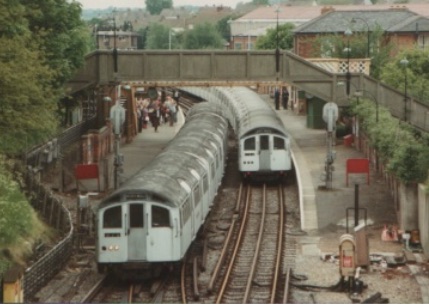
1959 stock epping Central Line 1950s

Initially, my father used to take us “Into Town” to Bank on the Central Line, where he worked on some Saturdays as a sugar dealer’s clerk. Our annual Christmas trips to Selfridges and Wembley’s “Something-on-Ice” shows or Chipperfield’s Circus took me further along the Central Line and introduced me to the Metropolitan Line. When I was old enough to travel alone, I undertook short single station journeys from Newbury Park to school at Barkingside, also on the Central Line, then further afield to Gants Hill and Redbridge. However, my real tube surfing began with Red Rovers!

My friends and I, for a relatively paltry sum, would travel to exotic places like Heathrow, to eat sandwiches and watch planes from the rooftop terraces; to Morden, simply because we thought it was the furthest station away and we could ride a bus to Mortlake, walk beside the Thames to Kew and eat sandwiches. We ate a lot of sandwiches! We’d go round and round the 17 mile circumference Circle Line (coincidentally the same circumference as the much later Large Hadron Collider under Switzerland), just for the fun of it, eating sandwiches, and travel to Earls Court, Olympia and South Kensington on the District Line for exhibitions and museums (“You can’t eat those sandwiches in here!”).

Circle 1970 Circle Line 1970s

Later, my love of classical music took me on trips along the District Line to Embankment, for the ridiculously windy walk across Hungerford Bridge to the Royal Festival Hall, and to South Kensington, for the ridiculously long underground walk to the Royal Albert Hall. Returning late at night was often a mad dash round the system to catch the last train home, and on one difficult night, when I was accompanying my sister’s German pen friend to a Promenade Concert (no, I’m not sure why either, but I was a perfect gentleman!), we managed to miss the last Central Line train from Notting Hill Gate. As we waited for my Father to drive across town to collect us at way gone midnight, this rebellious Mädchen thought it hilarious to play ‘knock down Ginger’ on the various high class doors along the street. I don’t know if this was the cause of Mr Hendrix, who lived in the area at the time, ending his life as a result of depression through sleep depravation, but I hope we didn’t bring about the demise of arguably the best guitarist the world ever knew. I very much doubt if my Father would have made the journey from Ilford if it had just been me, but it didn’t stop him making that journey again when my sister and I took him to the Strauss Promenade Concert on 30 July 1966.  Football aficionados will recognise that date as the day the ball DID cross the line in the Eighth Football World Cup, although the Russian linesman stated the line didn’t matter, as the ball rebounded off the net – not the crossbar. However, despite all the controversy, I remember it as the day when the entire population of London seemed to be celebrating along Pall Mall to Piccadilly Circus, as we made our way home from the concert.

Metropolitan 1990s
Metropolitan line in the 1990s

After spending six years at Bristol University and twenty one years working in Bristol, which sadly lacked an underground line or even trams and trolley buses, I returned with my family to Rickmansworth, and took to rattling along the Metropolitan line for business and pleasure trips into the metropolis. Working in Hillingdon also introduced me to the other end of the interminably slow Picadilly line. Even now, after a further seventeen years, the journey from Heathrow is long and slow – something the Heathrow Express was built to overcome, but failed miserably to provide a consistent and reliable service for the exorbitant fares. There is now even a consideration that a spur will be built from the High Speed 2 rail line beyond Denham, but that won’t happen (if at all) in my life time.

After the sad death of my wife, I coincidentally returned to my old stomping grounds in Essex and took to the Central Line again. How things had changed! The carriages were even hotter than I remembered them as a teenager, largely because there is now no ability to slide open any windows. There are some misconceived slots labelled ‘ventilation’, with encouragement to slide ‘on’ or ‘off’. But it’s my belief that Trading Standards should be informed of this inaccurate description, as I travel like a boiled prawn overground from West Ruislip in the baking sun, underground from White City in a steam pipe, rising briefly at Stratford to descend once more, before rising again for the baking above ground stretch to Theydon Bois.

But I see that it’s all about to change. Transport for London, under its great but politically temporary leader, Boris Johnson, has announced its intention to commission some comfortable, through access, air conditioned tube trains for use on the Piccadilly, Bakerloo, Central and, for some strange reason, the Waterloo and City lines, and I only have to wait until 2022/32. So, let’s see, by the time I’m 71/81 I might be able to travel to work in comfort. Hold on, I won’t be travelling to work when I’m 71/81!Metroplitan 2013

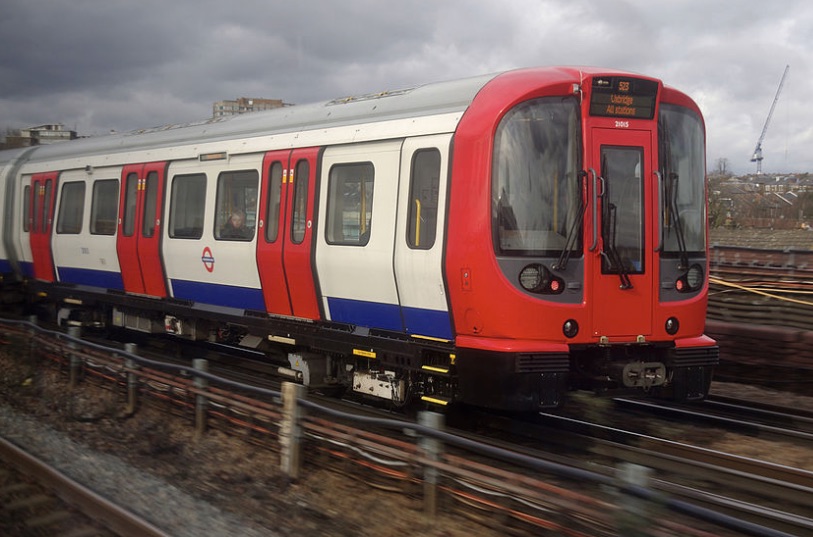
Metropolitan Line 2013 Metropolitan Line 2013

However, prior to my retirement, I travelled to work on the new, upgraded, comfortable, non-rattley, air-comforted (there are very few fully ‘air-conditioned’ installations anywhere), walk-through S stock trains. There have been a few changes to the Tube in the 60+ years I’ve been underground. Fire-extinguishers and emergency light candles have been removed – often by schoolboys, but more recently by policies. Smoking no longer blights our journeys. Alcohol has been banned – though not everybody realises that. Step-free access has improved – but needs to improve a lot more. Ticketing has become more slick – although thundering into the back of somebody at the turnstile who is required to “seek assistance” is still an annoyance, as is somebody thundering into you, trying to avoid paying the due fare.

Some things never change. The expectation that the first train to arrive will be destined for your station is as silly as it ever was. The laws of “The Tube” prevent that eventuality. I may want to go to West Ruislip in the morning, but I must wait for two travelling to Ealing Broadway before mine arrives. As a youth, I always wanted Hainault via Newbury Park, but no, two Epping or Hainault via Woodford Trains had to pass before mine arrived. Of course, now I live near Epping, the reverse applies.

There are still a few stations I need to visit, but hopefully I will achieve that before I go to the great turnstile in the sky. I wonder if He accepts Oyster?

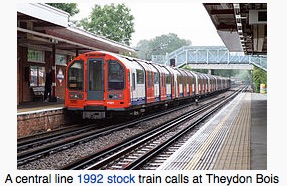
central 1992 TB It’s actually departing from Theydon Bois, Northbound.

A year on: Part 2 – A week in Provence

As described in “A year on: Part 1 – Still scarred, Ryannair!” I have travelled by air reasonably extensively over the past 40 years, but the combined efforts of French Air Traffic Control, Ryannair, idiot drivers on the M11 and the French A7, French children’s sport promoters, weather forecasters, Marseilles Provence Airport (mp2) and UK Border Agency have enrolled me into the Grumpy Old Man Brigade!

The delayed Ryannair flight described earlier was uneventful and we descended to the small runway at Toulon Hyeres, taxied to the quaint terminal building and walked out into the warm sunshine.  Queueless, we waited for our distinctive cases to arrive on the belt, expecting my Son to be waiting outside.

“Touriste!” A familiar voice bellowed in my ear. My French brother-in-law had sauntered into the baggage hall to greet us. “So, I thought maybe we have drink in Carquieranne?”

At this particular moment in time, having already missed a day in the sun, courtesy of his countrymen, I was more interested in getting to the hotel and grabbing what little there was left, than quaffing drinks in a bar by a quaint French harbour.  But it seemed churlish to refuse.  I looked at my Fiancée and my daughter, who had just arrived with buggy and kids, and all exchanged ‘we can’t refuse’ looks. When my son, who had driven the mini-bus from Aix, arrived, more exchanging of ‘we can’t refuse’ looks, and we bundled our baggage into the 9 seater Fiat to follow the fast driving small Peugeot to Le Pub in Carquieranne.

I have to say, Le Pub was not a bad experience and, at last, we had a chance to relax for a while, without the bustle of planes, queues and lugging bags around. The kids could let off steam and we could all contemplate a pleasurable wedding. A drink, a chat, a walk along the quayside, and we were ready to depart to our much awaited hotel near Aix-en-Provence.  And when we arrived all looked wonderful – except!

The room that my Fiancée and I were allocated had probably been a horse or cow stable before conversion into something that resembled … a horse or cow stable!  I didn’t even like to contemplate that it might have been occupied by pigs or chickens. A small double bed, with little room to manoeuvre round, was squeezed against the far wall from the door. The door itself was unable to open to it’s full extent, and a small window looked out onto an internal courtyard; a courtyard that we were to later discover would be occupied by overspill from the restaurant.  Ventilation would be achieved by leaving the window open and partially opening the wooden shutters, insecurely securing them with a rudimentary hasp. I didn’t even look at the small, sunless ensuite bathroom. What I had already seen was enough, as the room wasn’t even minimally sufficient to attempt to persuade my Fiancée that it might not be too bad; something I usually try to do, much to her annoyance.

A quick visit to Reception and an odd Franglais discussion enabled us to be given a palatial room on the first floor, overlooking the main road outside, but at least somewhere that was likely to provide a good sleep.  The bathroom, though not separated from the bedroom by a door, included a large walk-in shower and its own window. Positive luxury compared to the outhouse.

We settled in and all met for dinner, nice and early, to give us a chance of sleeping off the rigours of our protracted journey. However, although we were the first to arrive in the restaurant, inexperienced waiters, slow kitchen service and multiple muddled orders transpired to elongate our meal to one of those three hour sojourns that the French are so fond of.  A child’s desert even arrived at the table long after the child had retired to bed, exhausted.  The waiter deliberately avoided eye contact in order to be unaware of the problem, which of course was denied when we tried to complain.  With a typical Gallic shrug, and an explanation that the waiter was new, it was all put down to one of those things, and would we like complimentary drinks. When we got to the bar, that too appeared to be a misunderstanding and the bar staff (who of course didn’t speak English) attempted to charge for the alcoholic beverages. She obviously hadn’t heard of my tenacity in extracting complimentary drinks from wayward hostelries.  The manager, who appeared to be little more than 12 years old, was called and persuaded to provide the expected level of customer service – and so to bed.

I really should have realised, when researching the hotel, that if I could see the bedroom windows from the Google Streetview App, it was a sure fire certainty that I would be able to hear the street (Google or otherwise) from the bedroom window.  However, as we grabbed a reasonable amount of shuteye, we contemplated that it was infinitely better than sleeping in the cow shed!  Morning arrived, and we trooped down to the Restaurant, for a breakfast that was somewhat better than the previous night’s dinner. The main reason for this was the self service nature of the meal.  Any comment regarding what we were and weren’t allowed to eat was met with the reverse of last night’s responses – “Sorry, we don’t speak French.”

To avoid my son having to drive the mini-bus for the rest of our stay in Aix, it was decided that one of us would register as an additional driver. My daughter announced that she wouldn’t be drinking anyway so … “OMG. I should have realised when you didn’t drink at your cousin’s wedding last week!” Thus forthcoming new grandchild was let out of the bag.

It wouldn’t take too long to pop over to Aix International Rail Station, come back and enjoy an al fresco picnic and dress for the afternoon’s wedding, would it? Based on the delays that had already beset us, that question was not as rhetorical as it sounded. Waiting in line behind people who needed a dictionary and translator to perform the simplest of tasks, people who were far more important and only wanted to change their inappropriate car and people who simply thought booking their car was the opportunity to haggle for everything, was not a pleasant experience. “Bossy Boots” and fast growing teenage four year old were getting restless in the rapidly overheating mini-bus, and the adults even more so. To then be told that we could have registered quicker elsewhere did not make the experience any better. So a rush back to the hotel via a conveniently located Lidl that was having an inconvenient delivery blocking the car park, a rushed al fresco picnic by the tempting but out of bounds pool and a hasty getting dressed led to a breakneck drive to the Hotel de Ville.  But we all made it, not in time to sit down anywhere and only just before the bride arrived, but we made it.

Standing through the ceremony, listening to the Mayor making, what we assumed were, jokes while still trying to catch our breath was an experience in itself.  At least we had a chance to slow down after the previous 48 hours mayhem, and the smiles on the happy couple’s faces brought smiles, again, to ours.  Many photos later, and we were off to the religious part of the wedding.

“There’s just a slight problem,” my sister said as we made our way to the cars. Had French Road Traffic Control come out in sympathy with their air colleagues?  The French usually have a habit of ganging up on us poor English.  No, it seemed that the car park closest to the Temple we were supposed to attend was closed, due to the local sports committee taking over the roads for a kids’ marathon race, and the nearest car park was a significant walk away.  This was not good news, as my Fiancée had been suffering severe pain for a few months when walking, pain that has only now, a year later, been corrected by minor (HA!) surgery on the hallux.  In order to find the car park, my son had to drive the mini-bus at breakneck speed, again, to keep up with my brother-in-law’s ‘continental driving’ of an ever so slightly smaller Peugeot. When we got to the designated car park, he disappeared down the car park ramp, while we removed the aerial and slowly negotiated the low headroom and tight corners, down and down, until we arrived at what might have accommodated our mini-bus. Where now? No sister, no brother-in-law, only an expensively charging roaming signal on my smart phone’s SatNav App. Off we set, with “Bossy Boots”, teenage four year old and hobbling Fiancée in tow. Eventually, we made it, past the marathon kids, thanking them so much for adding to the hectic enjoyment of our trip, past the shoe shops that we picked out for the return visit and past the car park that we should have used.

This time, we managed to sit down and enjoy a slightly more relaxed ceremony. Given that the officiator was American and a large proportion of the congregation was English, I wondered why the whole ceremony was conducted in French (including the jokes), but that didn’t lessen the joy of the occasion. So now, back to the mini-bus via a shoe shop, for some comfortable slip-ons, a street café for drinks and a supermarket for snacks. Then a leisurely drive to the reception venue – a bit too leisurely, as we missed the official family photographs.  However, an afternoon of bucket loads of champagne and delicious canapés softened the blow. As the afternoon merged into the evening, the wedding breakfast was served, the reminiscences of the happy couple’s school and university friends were performed and the cool French night descended.  The children were absolutely exhausted, so we returned to our hotel for the last night before taking my son and daughter-in-law to Marseille, to continue their holiday there and in Paris, and the mini-bus to the car-hire company to pick up two smaller cars for our holidays in Frejus and Port Grimaud the next morning.

At last we would all be able to relax in the sun for the rest of the week, free of the delays and bustle of the previous few days.  That is until the unforcast rain came on the first day and the unforcast wind for most of the rest of the week!  However, we all managed to get a bit of sun and sand, the latter blown into our nooks and crannies by the Mistral.

When it came to returning, the relatively early flight meant very early departures from Frejus and Port Grimaud. Fortunately my Daughter had left early enough to avoid the delays caused by a French driver entering the A7 and bouncing down the road into the central barrier.  We were not so lucky, and arrived at MarseilleProvence2 (quaintly termed mp2) departure lounge just in time for check-in.  We shouldn’t have worried, as check-in in the budget airline shed – there was nothing quaint or loungey about it, it was just the old terminal with a make-under – was a very leisurely affair. I realise that budget airline passengers are the scum of the earth, but I’ve never before had to weigh in my luggage, hoist it off the scales, wheel it round the corner and hoist it again on to the conveyor belt.  I was fully expecting to have to remove it at the other end and carry it all up into the plane’s hold, like the coach trips that haunted my childhood.  But no, I was spared that particular chore.  Having followed the inadequate signs to the departure gate, turned back and walked on a parallel route on the other side of some cattle fencing, we eventually arrived at the head of the mis-titled ‘Speedy Boarding’ queue.  Eventually, speedy boarders boarded and so began the free-for-all of the non-speedy boarders, of which my daughter, son-in-law and children were but four, and were almost crushed in the stampede.

  Up in the air, we passed over the mountains, which, a year later, were to claim the lives of the occupants of the German Wings flight, and eventually made our uneventful descent. It had been a while since I’d arrived as an international traveller in Stansted, and I wasn’t expecting the upgraded security of the UK Border Agency. We were herded along decreasing width corridors to an escalator that was frequently closed off, due to the density of the queues upstairs. We had become separated from the family, who were now trailing some way behind us. But when they got to the escalator, my son-in law and walking child were forbidden to use the lift that my daughter and buggy-riding granddaughter were ushered into on the grounds that they didn’t need this ‘precious’ resource. Inevitably when they got up to the severely overcrowded UK Border Agency, they were separated from each other and ourselves.  It took something like an hour to get through the procedure set up to ensure no foreign miscreants snuck in to steal our jobs, benefits and hospital beds. Why are obviously resident English people put through such misery to get back into their homeland?  It never used to be like that – oh dear I’m sounding like my late Father now.

Against the background of our previous delays, the journey from the airport home was stress free, and we breathed again like human beings rather than fare-paying livestock.  But I know that I’ll never fly Ryannair again, and probably never fly international back to Stansted!

A year on: Part 1 – I’m still scarred, Ryannair!

I had travelled by air reasonably extensively over the previous 40 years on business and pleasure  – high cost, medium cost, low cost and ‘Grace L. Ferguson Airline and Storm Door Company’ cost (for those who were brought up on a diet of Bob Newhart comedy).  However, my experience in 2014 has to rate as the worst ever. I’m not a picky person, I don’t shout “compensation” at the first sniff of a problem, but the combined efforts of French Air Traffic Control, Ryannair, idiot drivers on the M11 and the French A7, French children’s sport promoters, weather forecasters, Marseilles Provence Airport (mp2) and UK Border Agency enrolled me into the Grumpy Old Man Brigade!

I fully subscribe to the fact that workers have the right to complain about erosion of their pay and conditions.  I’m not so convinced that London Tube workers have the right to perpetuate jobs that are no longer viable (why maintain ‘Ticket Offices’ when few people actually need to purchase old-style tickets?). And although French Air Traffic Control workers, arguably, have the right to demonstrate their country’s ability to cut off their inhabitants’ robust noses to spite their own faces, trying to maintain a ludicrously uneconomic system of benefits and pensions, they do not have the right to disrupt the long-planned travel arrangements of the rest of Europe.

So it was that on Thursday 15 May 2014, my family and I attempted to travel to my niece’s wedding in Aix-en-Provence.  It was not going to be easy, with an 18 month old bossy boots, a 4 year old going on 14 in the party plus, unknown to us at the time but obvious by my daughter’s abstinence, a little one in the oven, but the travelling skills of parents and grandparents would surely overcome any minor problems.  Ah, but we hadn’t reckoned on the disruptive power of the French Air Traffic Controllers.  Nor had we considered the total incompetence of Ryannair staff to deal with the unfolding situation in a way that approached reasonable (not even good) customer service. Two hours of queuing, bag dropping, waiting for boarding instructions, queuing and getting to the boarding gate – even seeing some potential fliers descending to the tarmac to board the plane that had just disgorged its load – did not prepare us, or any of the other stunned passengers, for “Flight cancelled!”  I have never seen so many wide-eyed people standing in such silence, even if only for a few seconds, before the inevitable pandemonium.

“You’ll have to return to the desk to rebook,” from a reasonably disinterested suit, who had been pushed forward by the totally disinterested desk staff, did nothing to calm or instruct the increasingly restless crowd. There was no indication of how, where or when we were to accomplish the instruction, just “return to the desk”.  Within seconds, I had an email message posted to my phone, which was demonstrably smarter than Ryannair staff, apologising for the cancellation of one of my flights, which, of course, was not Ryannair’s responsibility, and advising me that I could rebook on line.  Rushing along with the crowd – still with no instructions – like lost animals in a wild stampede, our party broke up into an advance guard, who had no idea where she was going, a mediator, who was trying to gather all the party’s travel documents ready for the hassle of rebooking, and a sweeper, who was sweeping up the children and pushchair.

Blindly traversing long corridors, escalators, stairs and ‘staff only’ exits, I attempted the online rebooking – three seats only left on the next flight in the morning; not enough for the six of us. Flowing out into an already crowded check in area, I caught up with the advanced guard, who was near the front of a crowd that had already shifted from one designated desk to another.

“No, no, no. You don’t want E, you want F,” an obviously mis-titled Customer Services person bellowed.  “Madam, you can’t go under that barrier!”

“Can’t I?  You just watch me!” my Fiancée snarled has she regained her rightful place in the growing queue.

Why Ryannair, in their infinite wisdom, decided that rebooking 200 plus passengers, each taking 15 to 20 minutes to process, could be carried out by two individuals, is beyond me.  Why Mr O’Lairy also decided that training his staff in customer relationships was a waste of money, however, did not surprise me.  One of the dullards behind the desk responded to a French customer in front of us, “Yes sir, they did it deliberately just to annoy you.”

“No flights to Marseille until Saturday,” his colleague, Ms Disinterested advised.

“But the wedding is on Saturday!” I replied. No response. But after thinking about important things like the colour of her nails, what time her shift would end and how best she could annoy as many people in the shortest possible time, Ms Disinterested mumbled, “You can go to Toulon tomorrow.”

Fortunately, I am fully conversant with the geography of S France and, although the pre-hired mini-bus would be waiting at Marseille mp2, it was not going to be impossible to make suitable travel arrangements from Toulon Hyeres to our intended destination.  My Sister lives near to the alternative aeroport, and my Son (who had managed to board his flight from Heathrow and wait a couple of hours on the taxi-way) may have been able to collect the pre-hired mini-bus from Marseille, drive to the hotel in Aix and collect us the next day.  I quickly accepted the offer before the seats disappeared from the screen, but it then took another fifteen minutes of tapping, mouse manoeuvring, dawdling to the printer at the other end of the desk  and scrawling across pieces of paper, before we received our rebooked flight details.

Then, something happened that I had never heard or seen before emanating from Mr O’Laughable’s organisation.  In fact, I would surmise that when this becomes public, the desk clerk who uttered the amazing words has her days with the company well and truly numbered.

“It’s too late to check-in on-line, so you can get a printed version from the check-in desk at 9am….”  I then heard three words that I thought had been banned from the Ryannair dictionary of authorised expressions, “… free of charge!”  As it happened, I did check-in on-line that evening, but I was sorely tempted to wait until the next day, just for the exuberance of getting something out of Ryannair free of charge.

So, it only remained to pop back home in a taxi, rebook that morning’s taxi for the same again tomorrow and spend one more day in Essex, before jetting off for warmer climes.  Pop back home?  No sooner had the taxi entered the M11 that everything came to a grinding halt, as we noticed billowing smoke a little further down the road.

“Bet you’re glad this isn’t on a meter,” the once cheerful driver drearily intoned, as he pointed out the helicopter that had just landed ahead and the numerous ambulances, police cars, serious incident vehicles, and temporary screening wagons that were racing to the scene of the severe accident.

An hour later we were released from the blockage to continue the 35 minute journey, passing the devastation of a slewed horse box, three horses being walked around the motorway, one burned out car and one completely crushed car, having bounced it’s way down the carriageway and lodged at the front of a flat bed truck and trailer. Although very soon after we heard that a driver had been arrested on suspicion of dangerous driving, from my use of that part of the motorway, I would contend that the majority of road users on that stretch should be arrested for idiocy and the road designers for dangerous road design. Two exits in quick succession, the first having a slip road and the second a dedicated lane exit that immediately splits into two, is not a recipe for safe driving, especially when the users are likely to be first time visitors, foreign or both, on a tight time schedule and with conflicting advice from their passengers.  What possessed the road designers to add another junction for Stansted rather than remodel the existing one will never be known, but I can imagine it had something to do with money, land ownership or both.

So, after an unplanned stopover at Epping with my daughter’s family, we tried again the next morning. Negotiating check-in, security, Wetherspoon’s and the boarding gate again were all an absolute doddle, compared with the previous day.  Right up until the time the aircraft ‘rotated’ at 170mph, I was expecting a cancellation, but no, off we went into the cloudy skies above Essex, with not a hint of trouble.

I WILL NEVER FLY WITH RYANNAIR AGAIN!

My annoyance with French A7, French children’s sport promoters, weather forecasters, Marseilles Provence Airport (mp2) and UK Border Agency, will have to wait for Part 2.

Me; bombastic?

I’m often accused of using obscure words in my conversations or correspondence that listeners or readers do not understand. I must admit that I do use words that, occasionally, I need to check, and usually find that they do mean what I thought they meant.  A feature of using such words is that it is unlikely that the listener is going to check the meaning, and you can usually get away with it.

However, I have just discovered, using Google, that I made an ironic error the other day by misusing the word ‘turgid’ to describe a long, dull and overly complicated set of terms and conditions.  Although my own definition may not have been completely wrong, the term may, in fact, describe some of my more annoying communications – “inflated, overblown, or pompous; bombastic”

Note to self: never use words that you’re not entirely sure about. They may come back and bite you in the overblown bum.

A WordPress.com Website.

Up ↑